


What separates a good Analyst from a great one?
After working with hundreds of analytics professionals over the years, the following three attributes come to mind:
Strategic thinking
Technical proficiency
Communication skills
We call this the “Analytics Trifecta” because it represents the three core skills which can help you produce exceptional results at every stage of the data analytics workflow.
Strategic thinking is about understanding the business case, crafting an effective approach and measurement plan, and understanding exactly what it will take to deliver a successful outcome.
Technical proficiency is about rolling up your sleeves and executing your plan, which often involves a combination of data prep, profiling, engineering and analysis.
Communication skills help you bring the data to life, transform raw numbers into meaningful insights and narratives, and ultimately convince key stakeholders to take action.
A good Analyst might thrive in one or two of these areas, but a great one -- a true analytics unicorn -- excels at all three.
In this post we’ll dig deeper into each of these skills to help you unlock your own analytics superpowers.
Strategic Thinking
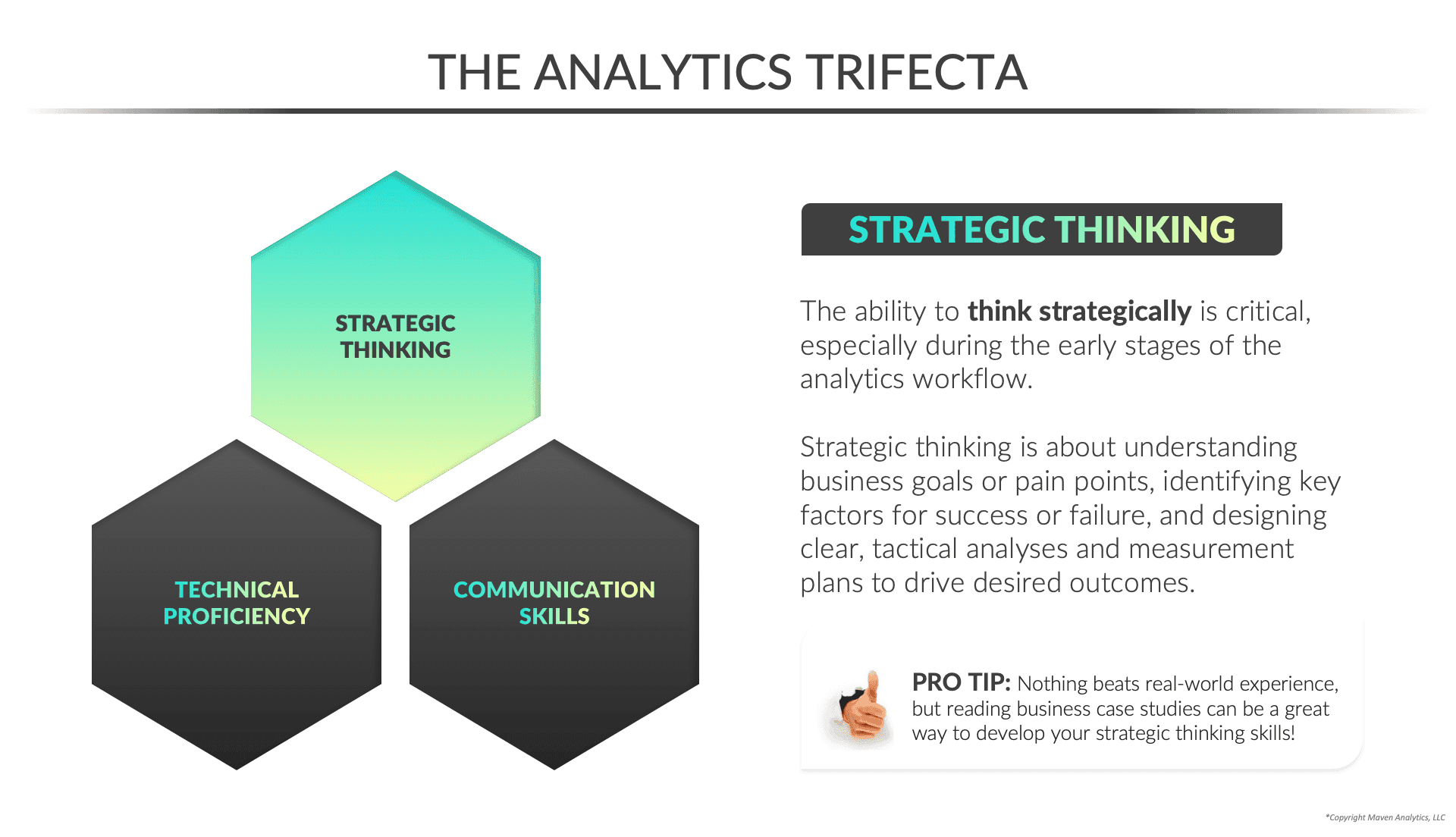
The ability to think strategically is critical, especially during the early stages of the analytics workflow.
Strategic thinking is about putting yourself in the mindset of the business owner. Doing this allows you to understand goals and pain points, identify key factors for success or failure, and design clear, tactical analyses and measurement plans to drive desired outcomes.
As an Analyst, thinking strategically will help you align on requirements, project scope, and desired outcomes from day one.
Remember that you don’t get paid to analyze data, you get paid to drive outcomes!
The best way to build strategic thinking is through real-world, on-the-job experience, which makes it one of the toughest skills to develop. That said, reading business case studies from places like Harvard Business School is a great alternative if you’re just kicking off your career or searching for an opportunity to get some real-world practice.
Technical Proficiency

Simply put, technical proficiency is the ability to execute, whether that’s writing code, building ETL pipelines, or designing data visualizations or dashboards.
If strategic thinking is all about establishing a roadmap for success, then technical proficiency is about executing that roadmap to perfection.
Strong, well-rounded technical skills allow you to contribute to a broader range of analytics projects, work more efficiently, and clearly showcase (and show off!) your skills.
That said, keep in mind that analytics tool landscape is MASSIVE. Rather than trying to learn everything, focus on building true expert-level skills in one or two areas first.
It’s better to be known as the Excel wizard or the SQL guru than the pretty OK analyst who is mediocre at a bunch of tools.
For BI Analysts, we recommend focusing on a core tool stack consisting of Excel, MySQL, and Power BI or Tableau.
Communication Skills

Think of an Analyst as a translator who sits between the raw data and the end users, whose mission is to transform raw information into clear and compelling insights.
While you may be able to "speak" the language of data, remember that many end users cannot. Therefore, your ability to communicate clearly is absolutely essential to your success as an Analyst.
For example, a strong, data-driven insight should explain what happened, why it happened, and (most importantly) how you recommend taking action.
If your analysis doesn’t inspire action or facilitate change, what purpose does it serve?
We're not just talking about written and verbal communication either; this includes all forms of outbound communication (written, visual, verbal, non-verbal) as well as the ability to listen, interpret, and process feedback effectively. These are all important communication skills to master.
Last but not least, remember that people respond to stories, not data points. Using effective data visualization and dashboard design techniques will help you create clear narratives that engage users and drive them towards key insights.
Wrapping Up
One of the most common mistakes we see Analysts make is focusing too much on technical skills and too little on strategic thinking or communication.
Don't make this mistake.
All three are equally important to your development as an Analyst, so it's important to assess your strengths and weaknesses and build a balanced skill set.
To sum it up, strategic thinking helps you understand how to evaluate and attack business problems, technical proficiency ensures that you have to skills to execute, and communication skills allow you to speak the language of your stakeholders and convince them to act.
Aim to build this “trifecta” of skills and you’ll be well on your way to becoming a true data analytics rockstar!
Happy learning 🤘
-Chris


Chris Dutton
Founder & CPO
Chris is an EdTech entrepreneur and best-selling Data Analytics instructor. As Founder and Chief Product Officer at Maven Analytics, his work has been featured by USA Today, Business Insider, Entrepreneur and the New York Times, reaching more than 1,000,000 students around the world.