



Data visualization brings data to life.
I love this statement. You would think it is just meant to be appealing (almost poetic), but the truth is that it’s based on facts -– which is exactly what data viz is all about! It’s not just about making beautiful charts that are pleasing to look at, but also about communicating insights clearly to help make data-driven decisions.
Data visualization sits on the intersection of art and science, and in this post we’re going to dig deeper into the latter.
The truth is that the human brain isn’t built to interpret raw data, at least not quickly and accurately. And I’m not talking about complex operations here. Seemingly simple tasks take up a high amount of brain processing power. Let’s look at an example:
Can you find the word “MAVEN” in this grid?

I’m sure you were able to find it, which is fantastic, but doing so took time and effort. You see, as you were trying to make sense of this non-visual information, your brain was relying on its prefrontal cortex. This is the part of the brain that is responsible for cognitive functioning & problem solving, which makes it slow and conscious. This means that no matter how many combinations of this word search puzzle I show you, it will always take time and effort. It’s not you… it’s science!
But what if we add some color to the mix?

This was a brand-new puzzle, and I guarantee it didn’t take you more than a few moments to find it. In fact, you probably spotted the word “MAVEN” before even having to think about it. That’s because in this scenario, your brain used its visual cortex instead. This part of the brain is responsible for visual perception and understanding, which means it helps us make sense of colors, patterns, shapes, and sizes. And, as you just witnessed, it’s instantaneous and subconscious.
Granted, word search puzzles aren’t a part of any analyst’s job description, but here's the best part:
Data visualization puts both our prefrontal and visual cortex to work, combining the power of cognition (slow and conscious) and perception (instantaneous)
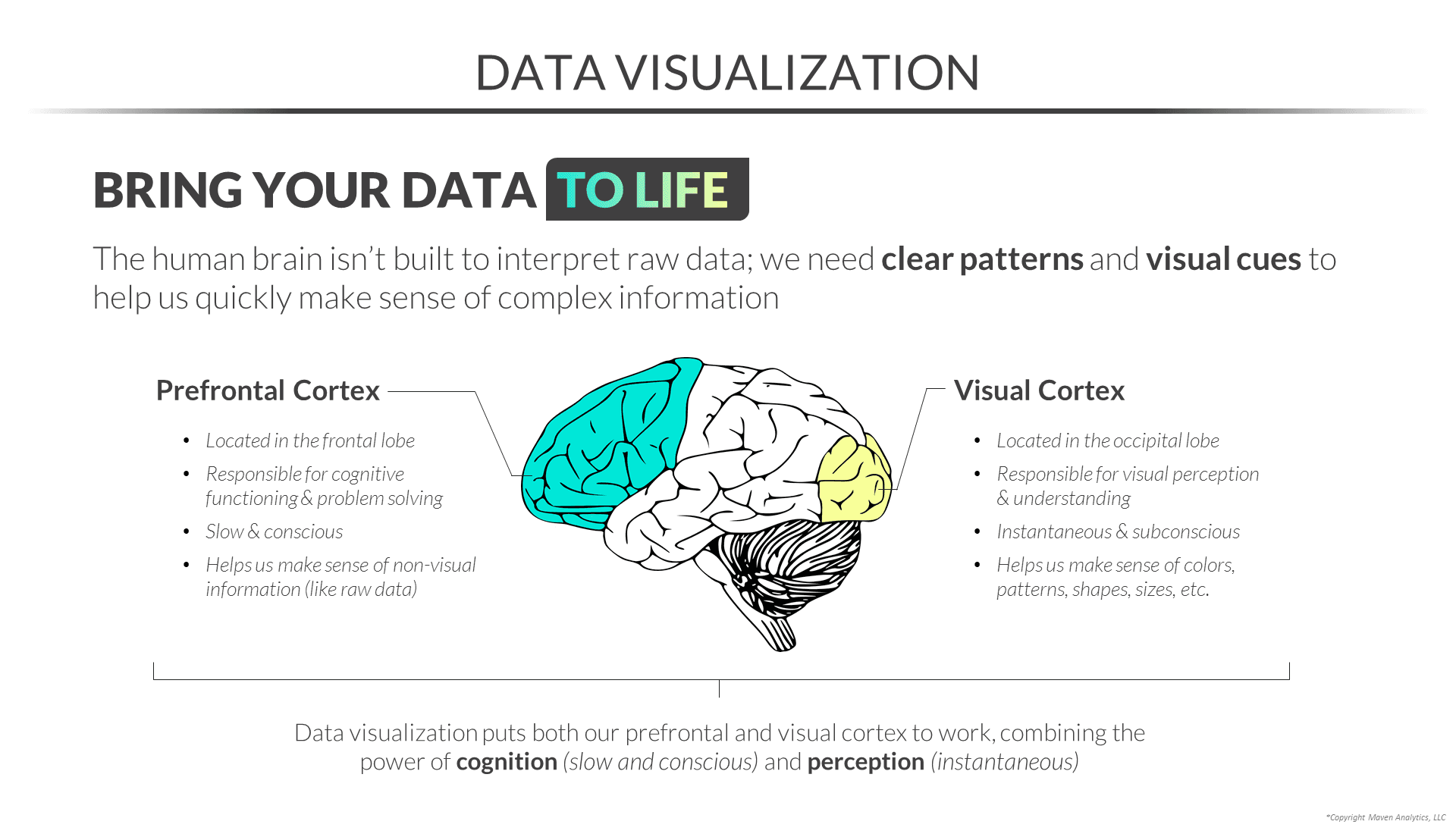
This is the scientific reason why data visualization is such an important skill to learn as an analyst. It allows you to understand large sets of complex data both quickly AND clearly. In other words, data visualization allows you to bring your data to life.
A short way to test this is through the “10 second rule”:
In 10 seconds, what can you learn from the data below?

Beyond noticing that the table is showing sales figures for 4 products over a 12-month period, it’s hard to fully pick up on any interesting patterns or trends in the data. And the same would probably be true if given a minute instead of 10 seconds, because we’re only taking advantage of our prefrontal cortex.
But what if I visualize this data?

Just like that, 10 seconds is enough to not only get a clear idea of the sales trends for each product, but to also start generating some about ideas about where to dig a little deeper. This is huge! Now we’re not spending most of our time trying to understand the data, but rather in trying to use that understanding to drive improvements to the business. That’s where real value comes from.
So the next time you’re find yourself filling your reports to the brim with data tables, remember the importance of data visualization and start plotting those numbers on an appropriate chart. I'm sure at least one person will thank you for it.
Happy visualizing!
-Enrique
P.S. If you liked this content, you’ll love my Advanced Dashboard Design course. It takes the data visualization & dashboard design topics covered in our Thinking Like an Analyst course and builds on them using real-world projects in Excel.


Enrique Ruiz
Sr. Learning Experience Designer
Enrique is a certified Microsoft Excel Expert and top-rated instructor with a background in business intelligence, data analysis and visualization. He has been producing advanced Excel and test prep courses since 2016, along with adaptations tailored to Spanish-speaking learners.